
- info@service.digitalmarketingvidyapeeth.com
support@service.digitalmarketingvidyapeeth.com - Pioneer Residential Campus for NDA, Near Khandoba Temple, Raywadi road, Loni Kalbhor, Maharashtra 412201

Blog Details
01
Jul
Entity SEO vs Keyword SEO: Which Strategy is Better in 2026?
Entity SEO vs Keyword SEO: Which Strategy is Better in 2026?
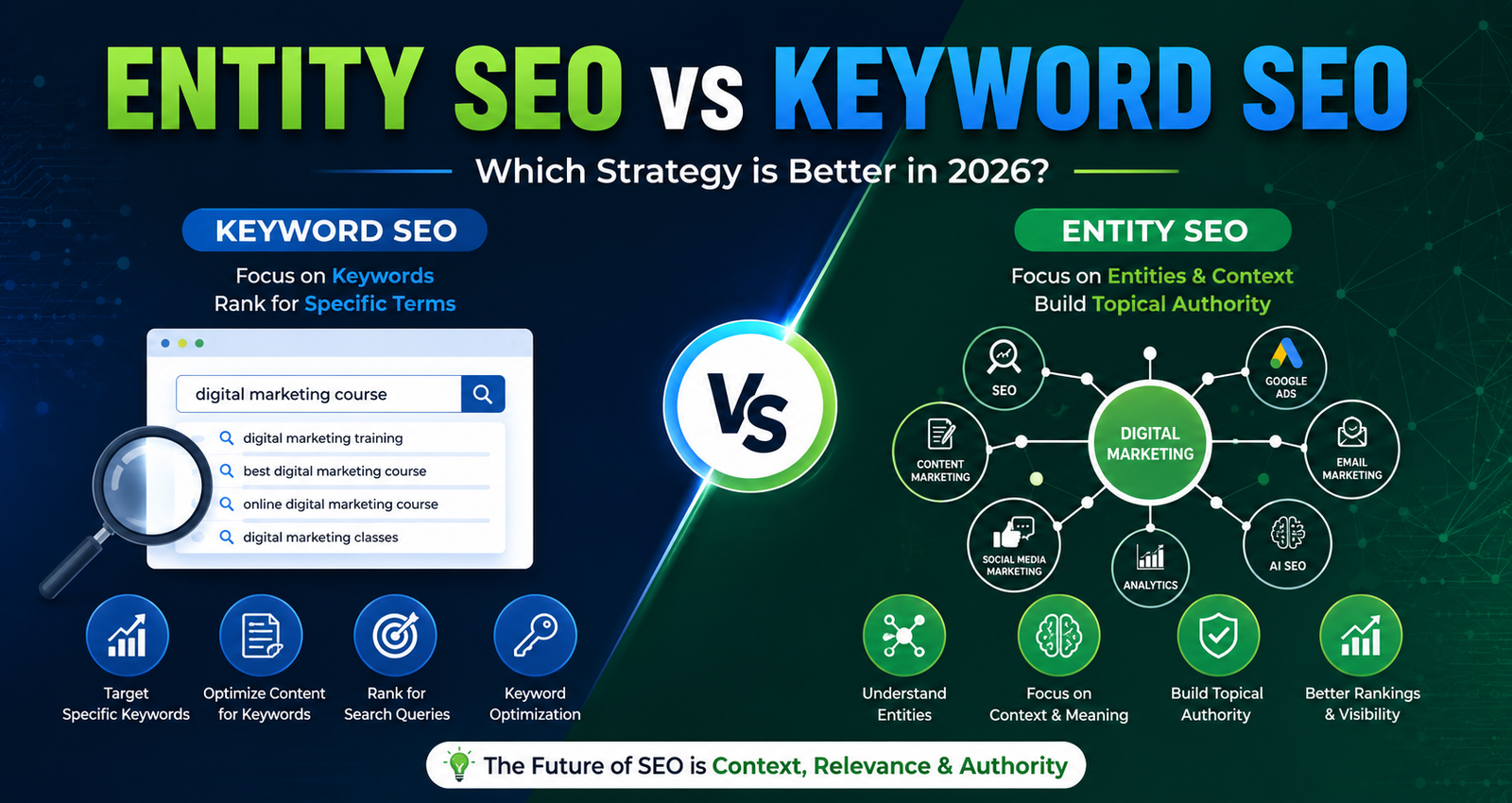
Entity SEO vs Keyword SEO is one of the most discussed topics in modern Search Engine Optimization. As Google becomes smarter with Artificial Intelligence, it no longer relies only on keywords to understand content. Instead, it focuses on entities, context, relationships, and user intent. If you still optimize your website using only keywords, you may miss valuable ranking opportunities.
In this blog, we'll understand the complete difference between Entity SEO and Keyword SEO, their advantages, disadvantages, and why combining both strategies gives the best SEO results.
What is Keyword SEO?
Keyword SEO is the traditional SEO method where a webpage is optimized around specific keywords users search on Google.
Example:
Main Keyword:
Digital Marketing Course
Related Keywords:
- Best Digital Marketing Course
- Digital Marketing Training
- Digital Marketing Classes
- Online Digital Marketing Course
The goal is to naturally place keywords in:
- Title
- Meta Title
- Meta Description
- URL
- Heading Tags
- Content
- Image Alt Text
Google uses these keywords to understand the topic of your webpag
Advantages of Keyword SEO
- Easy to understand
- Good for beginners
- Improves search rankings
- Works well for low-competition keywords
- Helps target specific search queries
Limitations of Keyword SEO
Today, Google understands language much better than before.
Problems include:
- Keyword stuffing penalties
- Doesn't fully understand user intent
- Similar keywords compete with each other
- Less effective for AI-powered search
What is Entity SEO?
Entity SEO is an advanced optimization strategy where Google understands real-world people, places, brands, organizations, products, and concepts instead of just keywords.
Example:
Instead of only optimizing for:
Digital Marketing
Google understands related entities like:
- SEO
- Google Search
- Google Ads
- Content Marketing
- Social Media Marketing
- AI SEO
- EEAT
- Search Intent
All these are connected as entities inside Google's Knowledge Graph.
This helps Google better understand the context of your content.
Why Entity SEO is Important
Modern search engines focus on meaning rather than exact words.
Entity SEO helps Google understand:
- Who
- What
- Where
- When
- Why
- Relationship between concepts
This improves topical authority and search visibility.
How Google Uses Entity SEO
Google connects information using:
- Knowledge Graph
- Natural Language Processing (NLP)
- Machine Learning
- Semantic Search
- Artificial Intelligence
Instead of matching only keywords, Google understands relationships between entities.
Example:
If someone searches:
"Best SEO Course"
Google understands that the user may also need information about:
- Digital Marketing
- Google Search Console
- Backlinks
- Technical SEO
- Content Marketing
Even if these exact words aren't repeated many times.
Keyword SEO Still Matters
Many people think keywords are dead.
That's completely wrong.
Keywords still help Google identify the primary topic.
However, relying only on keywords is no longer enough.
Today, successful websites combine:
- Primary Keywords
- Secondary Keywords
- Related Entities
- Search Intent
- High-quality Content
Best Practices for Entity SEO
Use Structured Data
Schema markup helps Google identify entities.
Build Topical Authority
Write multiple blogs around one topic.
Example:
- SEO Basics
- Technical SEO
- On-page SEO
- Entity SEO
- Semantic SEO
Entity SEO + Keyword SEO = Winning Strategy
The best SEO strategy combines both approaches.
Instead of choosing one over the other:
✔ Use keywords for optimization.
✔ Use entities for context.
✔ Focus on search intent.
✔ Build topical authority.
✔ Create helpful content.
This combination improves rankings across traditional search, AI search, voice search, and semantic search.
Leave a Comment