
- info@service.digitalmarketingvidyapeeth.com
support@service.digitalmarketingvidyapeeth.com - Pioneer Residential Campus for NDA, Near Khandoba Temple, Raywadi road, Loni Kalbhor, Maharashtra 412201

Blog Details
15
Jul
AI Dashboard vs Traditional Dashboard: Which One is Better for Modern Businesses?
AI Dashboard vs Traditional Dashboard: Which One is Better for Modern Businesses?
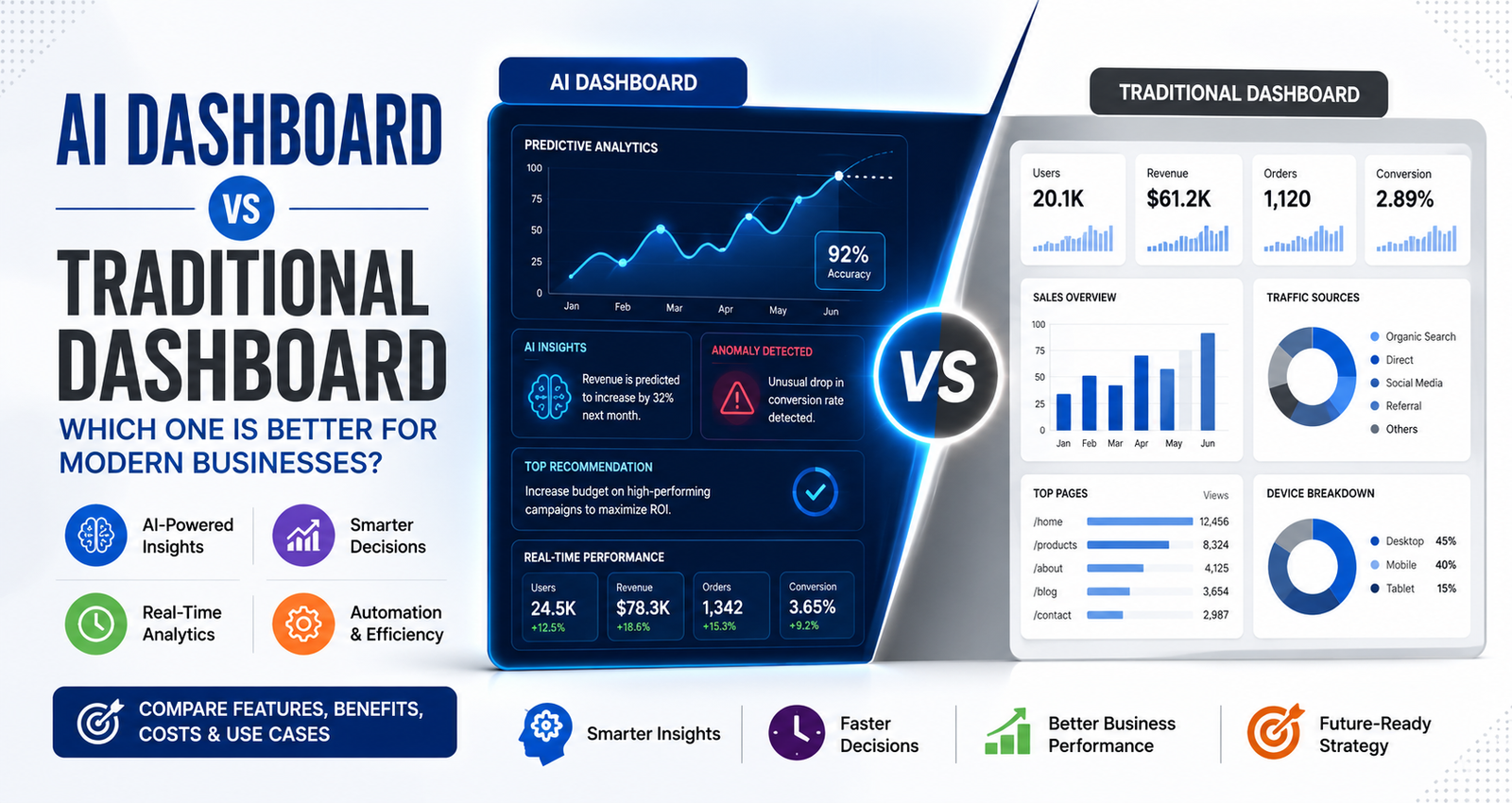
AI Dashboard vs Traditional Dashboard is one of the most important comparisons for businesses that want to make smarter decisions using data. Dashboards help organizations monitor performance, track KPIs, and understand business trends. However, with the rise of artificial intelligence, AI-powered dashboards are transforming the way companies analyze and use data.
Traditional dashboards have been used for years to display reports, charts, and performance metrics. They provide historical data and help managers review business activities. AI dashboards, on the other hand, go a step further by offering predictive insights, automation, anomaly detection, and intelligent recommendations.
In this blog, we will compare AI dashboards and traditional dashboards to understand their features, benefits, limitations, and the situations in which each one is most useful.
What is a Traditional Dashboard?
A traditional dashboard is a reporting interface that displays data through charts, graphs, tables, and KPIs. It collects information from various systems and presents it in a visual format.
Common Features
-
Static reports
-
Historical data analysis
-
Manual data updates
-
Basic filtering and sorting
-
Performance monitoring
Advantages
-
Easy to understand
-
Lower implementation cost
-
Suitable for small businesses
-
Works well for standard reporting
Limitations
-
Limited predictive capabilities
-
Requires manual analysis
-
Slower decision-making process
Cannot automatically identify patterns
What is an AI Dashboard?
An AI dashboard combines traditional visualization with artificial intelligence and machine learning capabilities. It not only displays data but also analyzes it automatically.
Common Features
-
Predictive analytics
-
Automated insights
-
Real-time anomaly detection
-
Natural language queries
-
Intelligent recommendations
-
Forecasting and trend analysis
Advantages
-
Faster decision-making
-
Improved accuracy
-
Automatic identification of trends
-
Reduced manual effort
-
Better forecasting
Limitations
-
Higher implementation cost
-
Requires quality data
-
Needs technical expertise
- May involve a learning curve
How AI Dashboards Improve Business Performance
1. Predict Future Trends
AI dashboards analyze historical data and forecast future sales, customer behavior, and market demand.
2. Detect Problems Early
Machine learning algorithms can identify unusual patterns such as sudden drops in revenue or spikes in customer complaints.
3. Save Time
Instead of manually creating reports, AI dashboards generate insights automatically.
4. Improve Marketing ROI
Businesses can optimize campaigns using predictive audience analysis and performance recommendations.
When Should You Use a Traditional Dashboard?
A traditional dashboard is suitable when:
-
Your business has a limited budget.
-
You only need basic reporting.
-
Data volumes are relatively small.
-
Teams prefer simple visualizations.
- Historical analysis is sufficient.
When Should You Use an AI Dashboard?
An AI dashboard is ideal when:
-
You manage large amounts of data.
-
Real-time decision-making is important.
-
You need forecasting capabilities.
-
Business operations are complex.
-
You want automation and intelligent insights.
Future of Business Dashboards
The future clearly points toward AI-powered analytics. As businesses generate more data, manual analysis becomes increasingly difficult. AI dashboards are expected to become standard tools for organizations seeking competitive advantages.
Features such as conversational analytics, automated reporting, predictive alerts, and personalized recommendations will continue to evolve, making dashboards more intelligent and user-friendly.
AI Dashboard vs Traditional Dashboard is not simply a comparison of old versus new technology. It is a comparison between reactive reporting and proactive intelligence.
Traditional dashboards remain useful for businesses that need straightforward reporting and cost-effective data visualization. However, AI dashboards provide deeper insights, predictive capabilities, and automation that can significantly improve business performance.
If your organization relies heavily on data-driven decisions, real-time monitoring, and future forecasting, investing in an AI dashboard can offer substantial long-term benefits. For smaller businesses with basic reporting needs, a traditional dashboard may still be the most practical choice.
Ultimately, the right dashboard depends on your business goals, data complexity, budget, and growth strategy.
Leave a Comment